Standing Up: Testimony, Confrontation, and the Fight for New Jersey's Shield Law
What solidarity looks like.

Currently, 27 states have laws banning gender-affirming care for minors. Fourteen states have total abortion bans, with another seven prohibiting abortion at or before 18 weeks of pregnancy. In this climate, states with shield laws aren’t a luxury — they’re a lifeline. As more states ban care, more people are forced to look beyond their borders to access it. Shield law states are where they look.
New Jersey has been a safe haven for transgender and gender-expansive people for years. In 2023, Governor Phil Murphy signed Executive Order No. 326, establishing the state as a refuge for gender-affirming healthcare, protecting both patients and providers from legal repercussions stemming from care that is perfectly legal here. But an executive order, however powerful, is not a law. Laws endure administrations. Laws have teeth.
That’s what Assembly Bill A2218 is about.
This past week, I testified before a New Jersey Assembly Committee considering whether to advance A2218 — the state’s version of a shield law — out of committee to a full Assembly vote. Similar laws exist in 19 other states, with Hawaii being the most recent to adopt one. In essence, a shield law protects medical practitioners, healthcare providers, and the patients who seek their services in New Jersey from civil and criminal prosecution in other states. It draws a line in the sand: what happens here, legally, is not subject to the reach of legislatures in Texas or Florida or any other state determined to criminalize the act of caring for a child.
I was originally asked to testify before the Senate, which was considering its companion bill, S2260, on Monday. My schedule didn’t cooperate, and I missed it. But as luck would have it, my morning was open when the Assembly took up its version. I was not going to miss this one.
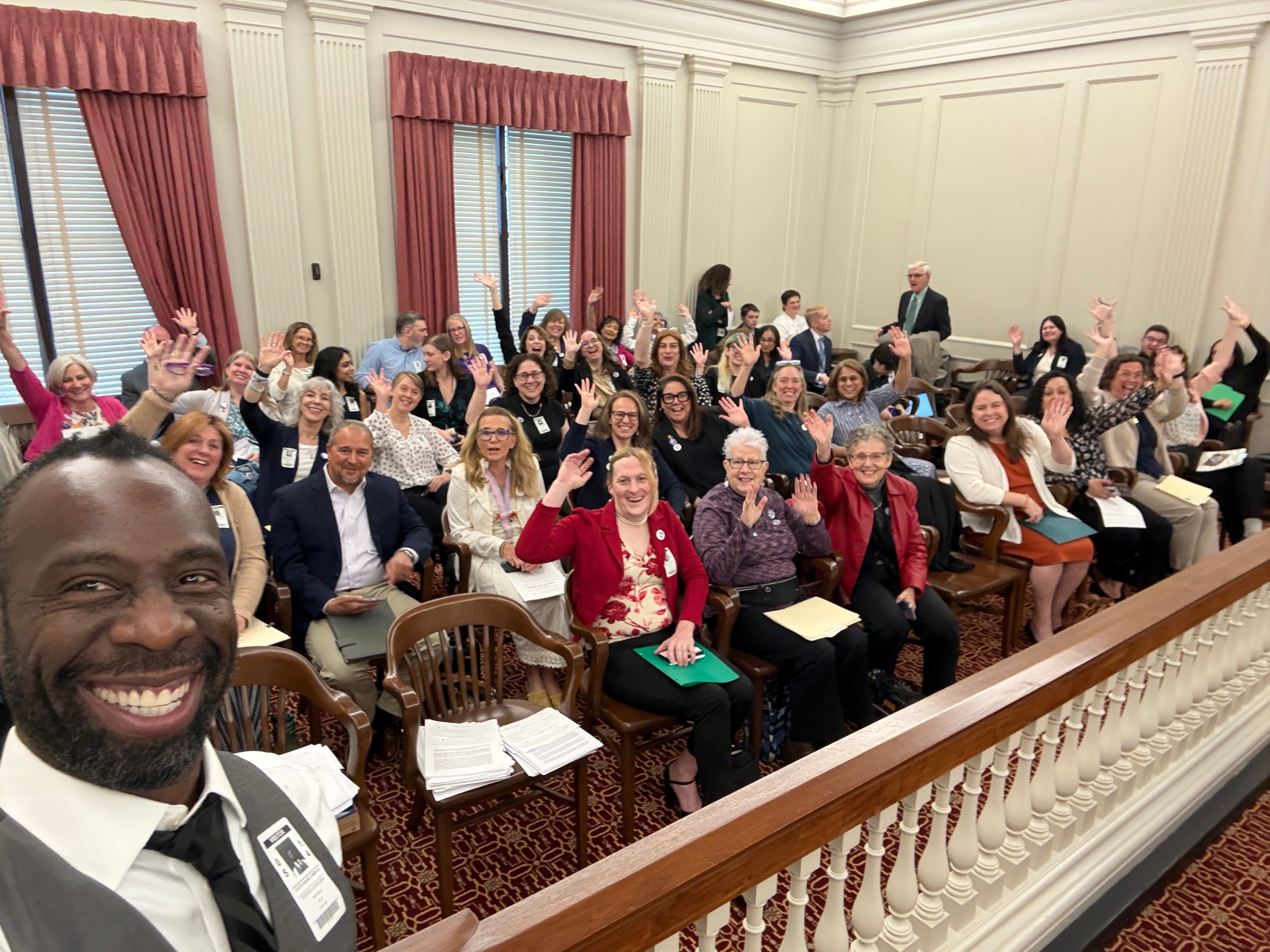
When I arrived at the State House, I was met by a sea of familiar faces. Other parents of gender-expansive kids. Trans elders who have been fighting this fight longer than most of us have been paying attention. Trans youth, who somehow manage to show up with more grace and courage than the moment has any right to demand of them. Advocates from Garden State Equality, members of the Transgender Rights Coalition of New Jersey — who had invited me to offer testimony — and allies I’ve shared stages, panels, Pride marches and protests with over the years.
This was my first time testifying on behalf of trans people in a formal public hearing. I’d shared our family’s story before — twice with the Equality Caucus in Washington, D.C., in private meetings with congressional leaders. Those conversations were impactful. I remember one representative excusing herself mid-meeting to attend a floor vote and later citing a story shared by another family in that room to support her position on the floor. That’s how much those stories mattered.
But those meetings were off the record. Private. Safe. There was no transcript, no recording, no risk that what we said would be turned against us. We were in rooms with people who had already decided they were on our side. Yesterday was different.
As the hearing room filled, I noticed the people I didn’t recognize. Faces set hard. Folders clutched tightly. Eyes that avoided contact with most of us in the room. They were mostly older, white, and conspicuously standoffish — a sharp contrast to the warmth and easy familiarity radiating from the supporters around me. I made note of them without fully understanding why, the way you register a shift in weather before the clouds arrive.
I had been given number 12 when I arrived at Committee Room 16 in the State House Annex, which I took as a good sign — the room was already packed, with people clustered in corners and crowded in front of the door. At one point, a State House staff member entered to announce that overflow rooms had been set up in rooms 14 and 15, and asked those standing to clear the aisles.
What happened next is something I want to describe carefully, because it matters — not just as an anecdote, but as a window into exactly what families like mine are up against.
One of the men standing near the door — one of the men I hadn’t recognized — turned to confront the woman making the announcement. He spoke aggressively, positioning himself inches from her face. He told her he’d been coming to the State House for 30 years and had always stood in the aisles when hearing rooms were full. He said he wasn’t going anywhere.
The woman, visibly shaken, turned to walk out of the room. He followed her.
I followed him.
I couldn’t sit there and watch that. This woman was doing her job. She wasn’t a combatant in anyone’s culture war. She was a State House employee telling people where the overflow rooms were. And this man had chosen her — a woman simply doing her job — as a suitable target for whatever was boiling over inside him.
In the hallway, she had stopped to make a call, and he was still at her, still inches from her face, still insisting he didn’t have to go anywhere. Instinctively, I stepped between them and placed my hands on his shoulders, intending to gently guide him back.
That was a mistake in method, if not in spirit.
He immediately erupted: “Don’t touch me! Don’t you put your hands on me!” He was right. I hadn’t asked. I withdrew my hands immediately and apologized — and then I said, plainly and directly, “You shouldn’t be treating her this way.”
He kept going, repeating his objections to being touched even though I was no longer touching him. But something had shifted. His anger, which had been trained entirely on the woman, was now directed at me. And she had already called building security.
Once he realized security was coming, he turned and walked toward the overflow room. The situation defused. I walked back into the hearing room.
I want to be honest about what I was thinking in that moment, and in the hours since. My intervention wasn’t heroic. I made a tactical error by putting my hands on a stranger without consent, and I own that. But I also believe, without equivocation, that when you see someone being harassed — when someone is using their size and aggression to intimidate a woman who cannot simply walk away from her job — you don’t look away. You step in. That impulse, that instinct, is the same one that brought me to the State House in the first place: the belief that when someone is being bullied, the right thing to do is stand between them and the person doing the bullying.
That’s what advocacy is. Sometimes it happens at a microphone. Sometimes it happens in a hallway.
About fifteen minutes later, the committee chair called the next group of witnesses opposed to the bill. And through the doors walked the man from the hallway.
When it was his turn at the microphone, he opened with four words: “I’m a former homosexual.”
Everything snapped into focus.
He went on to explain that his opposition to the shield law was rooted in his desire to protect “detransitioners” from what he called “gender ideologues, doctors and hospitals whose only interest is making money” by pushing “experimental, unproven, and harmful procedures on children.” He spoke of regret. He spoke of harm. He spoke of the people he believed the bill would hurt.
What he did not speak of were the people in that room. Not the trans man who had crossed state lines to access care. Not the seventeen-year-old sitting a few feet away, waiting to share his story. Not the mother who would soon stand at that same microphone with tears streaming down her face, talking about what gender-affirming care had meant for her daughter’s life.
This is the pattern I’ve come to recognize in testimony opposing care for transgender people and reproductive rights. The opponents often claim to feel genuine compassion — for detransitioners, for women, for children. And perhaps some of them do. But their concern is always for the hypothetical: the person who might regret, the procedure that might go wrong, the harm that could happen. That hypothetical concern consistently overrides the actual lived experiences of the real people who show up to say: this care saved my life. This care allowed me to be myself. Without this care, I would not be standing here.
I don’t have a clean answer for how to reach someone like that. But I know that the answer is not silence.
After about an hour and a half, I was called to the microphone along with three others in support of the bill.
I shared the moment with Aaron Potenza, a trans man and former board member of Garden State Equality, who described how he and his husband had to cross state lines to access care — and what the shield law would mean for families who know, firsthand, the cost and fear of leaving your home state to receive medical treatment that should be available down the street.
A seventeen-year-old trans boy testified next. He described coming out to his mother two years ago — and her unwavering support. He spoke with clarity about why the shield law mattered: without it, healthcare providers might leave New Jersey rather than risk prosecution in states where the care they provide is now illegal. His voice was steadier than most adults I know.
He was followed by a mother of a trans daughter. She spoke through tears about what gender-affirming care had meant for her child — not in abstract terms, but in the particular, irreplaceable terms of a mother who watched her daughter become herself.
Then it was my turn.
I steadied myself. My statement was written. I’d practiced it. I still felt the nerves — the awareness that this room, unlike the private meetings in Washington, was on the record. There was a microphone and a committee and people who would challenge what I said if they could.
I testified that just as my late wife’s medical team was free to treat her breast cancer a decade ago without political interference, my son Hobbes’ care team must be protected to provide the comprehensive, evidence-based treatment he needs to thrive. I told the committee that gender-affirming treatments are standard, established medical tools used in the care of both cisgender and gender-expansive children — and that political attacks and out-of-state subpoenas are driving vital specialists out of medicine, not because the medicine is wrong, but because they fear criminal and civil liability for doing their jobs. I asked the committee to advance A2218 — to shield our indispensable medical professionals from political intimidation and out-of-state overreach, and to ensure that my son and families across New Jersey can continue to access the life-saving, best-practice healthcare they deserve.
When I finished, the room erupted.
I was simply grateful I had gotten through it without breaking down.
Several people found me afterward to say thank you — for being there, for speaking, for being, as one person put it, the only father’s voice in the room that day. That landed harder than the applause. It reminded me why showing up matters, even when it’s inconvenient, even when it’s uncomfortable, even when it means stepping into a hallway to stand between a woman and a man who’s decided she doesn’t deserve basic decency.
We show up because the people we love deserve it. We show up because the hypothetical compassion of those who oppose this care does not outweigh the real lives of the real people in that room. We show up because silence, in this moment, is a choice — and it’s not one I’m willing to make.
The committee voted A2218 out of committee. The fight continues.
Stephen! My regret is that I didn’t get to meet you. I was sitting right in front of you in the pink sweater. I saw the interaction you described. Thank you for stepping up to help the staffer! I was also so grateful for your testimony about Hobbes! You’re wonderful! Perhaps we’ll meet another time!
Thank you friend 😭❤️🔥👊 You have put all of yourself out for the world to witness and I am grateful for your loving example. And thank you for raising the next generation of wholehearted community advocates.